


Please Contribute Here to help us Grow!
As New Zealand (NZ) inches closer to signing the comprehensive bilateral “new-wave” Free Trade Agreement (FTA) concluded in December 2025, a detailed analysis in a recent op-ed piece provides important insights on how both countries can leverage on it to generate positive win-win outcomes for both countries amidst shifting geo economic and geo strategic dynamics, including the ongoing Gulf war, which is reshaping the global order. The FTA provides a legal basis for both countries to deepen their bilateral economic relationship, reducing or eliminating existing barriers to the same.
This article which summarizes the above, is presented in two parts. The first part analyses the strategic context and economic benefits from the FTA in terms of goods, services trade and investments. The second part focuses on the labour mobility provisions and the Pacific gateway strategy offered by this unique agreement.
The strategic context
This FTA should be viewed in the backdrop of the acute challenges both countries face in sustaining national resilience by securing markets, managing supply chains, widening technological and other options, and ensuring political support among policymakers and the population for pursuing growth-enhancing policies. This new wave FTA offers opportunities to improve national resilience of both India and New Zealand by carefully choosing specific complementary areas which can help fill the existing gaps in the areas noted below, as also analysed by the authors in an earlier article.
Why is this a new wave FTA for both countries? This is an agreement that will reduce barriers towards not just bilateral merchandise trade, but also in services trade investments, mobility clauses, technological aspects, and the orange economy which includes creative and cultural goods and services, involving both traditional knowledge and arts, including in health care, and technology-driven industries. The important fact is that the size of the economy, per capita income, population size, global rankings in merchandise and services trade, and other aspects notwithstanding, trust and confidence among the partners and consistency in relationships, even as governments change, assume much greater importance in the currently changing global order. These can only be acquired gradually with experience in dealings with the partners. Such FTAs also require a more sustained focus on outcomes over the medium term from the stakeholders if the desired outcomes are to be attained.
India and New Zealand: An Overview of Economy and Demography
New Zealand has a far higher per capita income than India, USD 57,000 as compared to USD 13,000 in 2026 on a Purchasing Power Parity (PPP) basis. The PPP is a macroeconomic tool that compares the buying power of different countries’ currencies using a common “basket of goods1.
However, as India has a much larger population than New Zealand, its overall GDP on a PPP basis in 2026 at USD 19.1 trillion far exceeds that of New Zealand (USD 0.3 trillion)1.
India has been growing at about three times faster than New Zealand in recent years, and this trend is expected to sustain for some more years. IMF’s April 2026 GDP projection is for India to grow at 6.5 per cent in 2026, the corresponding growth rate for New Zealand being 2.2 per cent. If this trend continues, the gap between the two in per capita income can be expected to narrow over time.

Advertisement

Advertisement
India’s total trade is also much larger than that of New Zealand and is much more diversified. Annual international trade in goods and services of New Zealand is around USD 100 billion, while the corresponding figure for India is around USD 1800 billion. India remains a major global trader driven by its manufacturing and services exports, while New Zealand’s trade is characterised by a high-value niche products in agriculture, education services, and tourism.
India currently ranks 5th globally in digitally delivered services, trailing only the US, UK, Ireland, and Germany. In contrast, for New Zealand, while its tech sector (Software as a Service (SaaS) and gaming) is growing rapidly, it remains a smaller player globally.
The key provisions of the New Wave India-New Zealand Agreement
Merchandise Trade: The FTA provisions for Merchandise trade through the Trade in Goods chapter provides the basis for the liberalisation of customs duties. The chapter text provides a mechanism for both NZ and India to consider accelerating, or broadening the scope of liberalisation set out in the annexed tariff schedules. It contains key provisions common across many FTAs, including incorporating key WTO provisions relating to national treatment, administrative fees and formalities, customs valuations, import and export restrictions, import licensing, and non-tariff measures.
It also provides for duty-free temporary admission of goods, of commercial samples, and goods that re-enter after repair or alteration, and reiterates the parties’ commitments not to apply agricultural export subsidies. The chapter is also expected to commit to sharing data on FTA preference utilisation and establish contact points through which a India and New Zealand can request detailed information and consultations relating to any measure it considers may materially affect bilateral trade in goods between the thereby reduce transaction costs of conducting bilateral trade.
The FTA addresses India’s critical need to improve productivity in agriculture, an area where New Zealand is globally competitive. The FTA includes the ” Agriculture Productivity Partnership”, designed to drive cooperation activities across multiple sectors. A Committee on Economic Cooperation and Technical Assistance will be created to accelerate cooperation in non-agricultural areas.
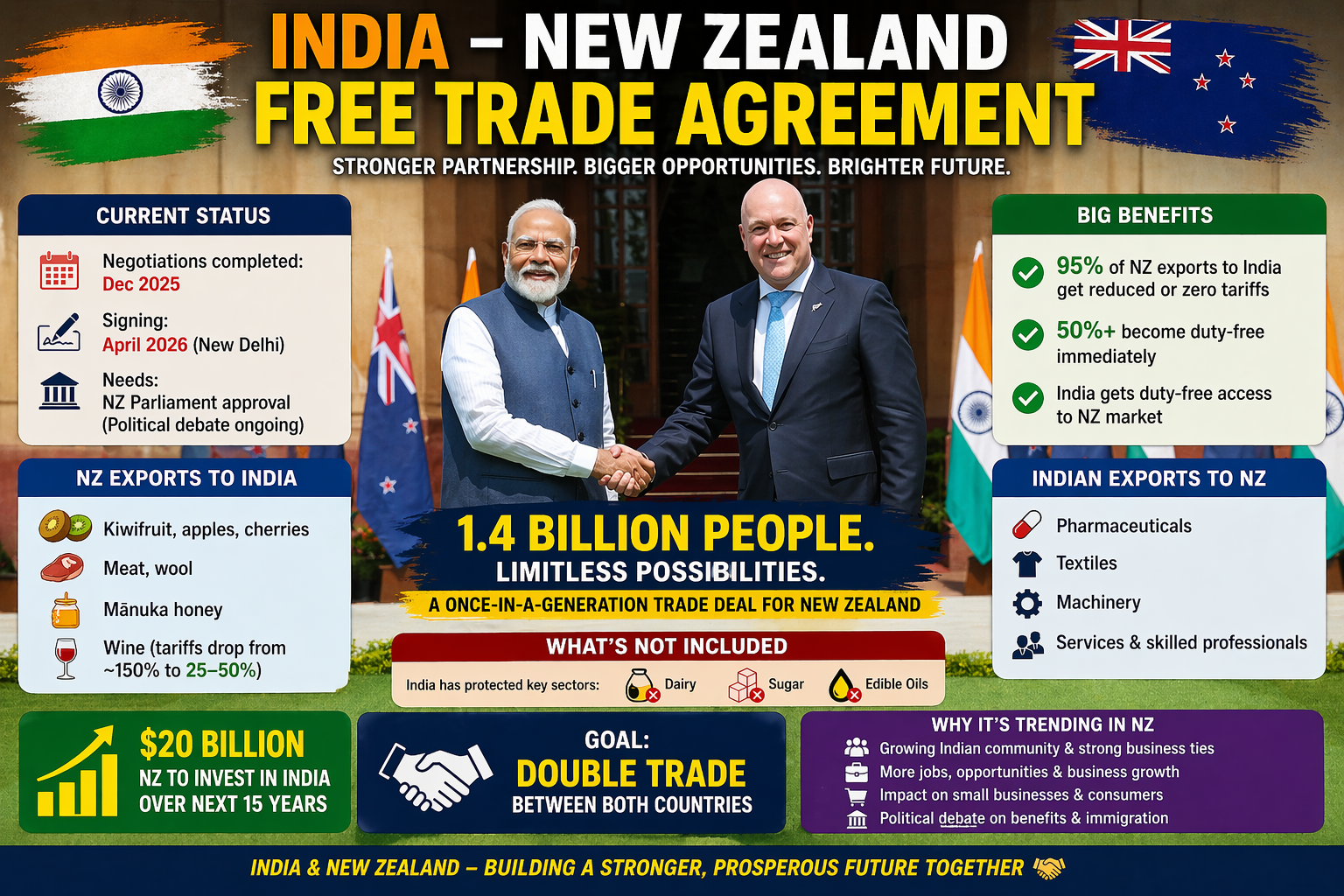
NZ benefits from 95% of its exports now being covered under preferential tariff reduction, with NZ forestry, sheep meat, wool, hides and skins exporters having to pay no duty the day from which this agreement is legally in force. Wine, Seafood exporters will pay significantly lower duties, progressively lowered over the years, while greater quantities of apple, kiwifruit, honey and milk albumins can be now exported to India, at progressively lower tariffs each year. High quality dairy ingredients from NZ can now be exported to India as an imported intermediate input, adding NZ into India’s dairy global value chains.
Advertisement
Services Trade and Investment Commitments
Two key outcomes are of economic and strategic significance for both countries. First, in the FTA, MFN (Most Favoured Nation) access has been provided to over 100 services sectors from both countries. From India’s perspective, investments in agri-businesses, renewable energy, infrastructure, and digital technologies from New Zealand are of significance. Further, the FTA allows Indian service providers MFN access to 118 service sectors across 139 sub-sectors in New Zealand, including Computer Related Services, Professional Services, Audio Visual Services, Other Business Services, Telecommunication Services, Construction Services, Distribution Services, Education Services, Environmental Services, Financial Services, Tourism and Travel related Services. As noted, in India’s total global trade, services account for around 47 per cent of the total, nearly twice the global average. Service provisions in the FTA, therefore, bring much-needed balance and fairness to the FTA.
An aspirational longer-term provision in the FTA is the USD $20 billion investment commitment by New Zealand private businesses over the next 15 years. A bespoke investment desk, like that for the EFTA (European Free Trade Association) countries, is expected to be set up by Invest India for this purpose. Invest India is the National Investment Promotion and Facilitation Agency of India, set up as a non-profit venture under the aegis of the Department of Industrial Policy and Promotion, Ministry of Commerce and Industry, Government of India.
Companies such as Zespri from New Zealand have been proactive, as indicated by them setting up a Kiwifruit Action Plan (KAP) launched as a flagship deliverable under the FTA, with the New Zealand Institute for Bioeconomy Science Ltd (BSI) and the New Zealand kiwifruit industry working alongside Indian kiwifruit growers in rural communities to support improved production and supply chain performance.
This is just one example of how New Zealand investments in India can be mutually beneficial. The technological know-how of New Zealand companies could find mutually beneficial investment opportunities in other areas of horticulture and selected industrial goods.
For realising investment commitments envisioned under the FTA, states, such as Maharashtra, Gujarat, Uttar Pradesh, and others in the east and northeastern parts of the country, who are pursuing development-oriented policies and whose economies have complementarities with New Zealand, should take proactive initiatives with a medium-term focus. This channel allows NZ businesses to scale up their operations in India, benefit from the knowledge spillovers, and reinvest growing profits back home, thereby generating additional income for Kiwi businesses from overseas investment.
The next part focuses on two other important win-win outcomes achieved through this FTA.
Advertisement
– By Sadhana Srivastava and Rahul Sen
The authors are trade researchers from Infinite Sum Modelling (ISM) Inc USA and AUT University, Auckland, New Zealand respectively. The views expressed here are personal.
Advertisement