


Please Contribute Here to help us Grow!
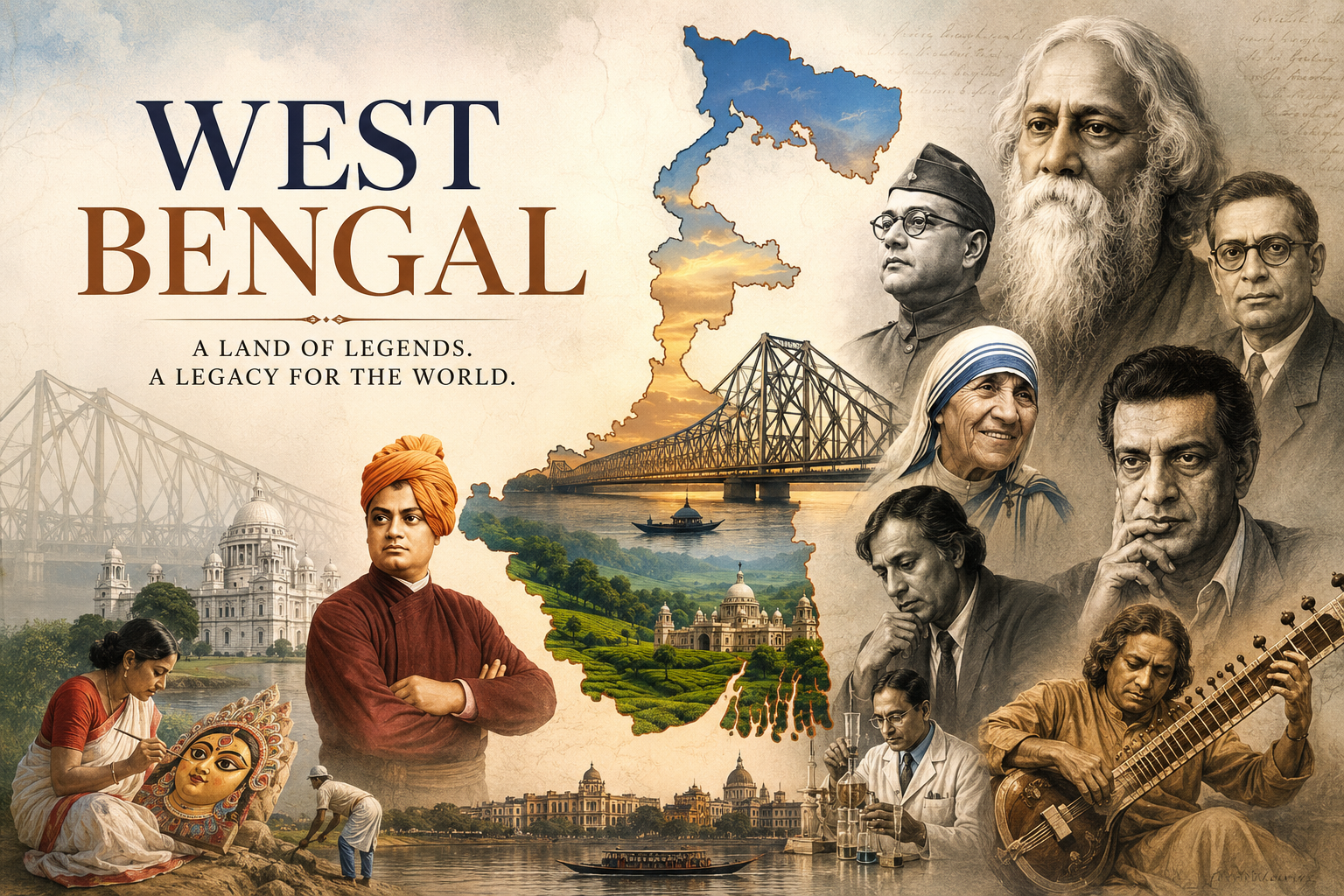
West Bengal is one of India’s most historically significant states. It has produced reformers, thinkers, artists, freedom fighters, scientists, musicians, mathematicians, Nobel laureates. Oscar recipients and led political movements that shaped not just West Bengal but India as a nation. Calcutta as it was referred to in the past, was once the intellectual, commercial and architectural capital of India, and Bengal’s cultural influence still extends far beyond its borders. Yet, despite this proud legacy, the state today requires a ‘serious political’ and ‘developmental turnaround’. It is not about turning India into a one-party state. The challenge is not merely about changing governments; it is about changing the style, priorities and culture of governance. It is about achieving a ‘paradigm shift’.
Bengal once stood at the forefront of India’s intellectual, industrial, educational and public life. This is not merely a sentimental claim; it is supported by history. In the nineteenth and early twentieth centuries, Bengal was the centre of the ‘Bengal Renaissance’, which produced reformers and thinkers such as Raja Ram Mohan Roy, Ishwar Chandra Vidyasagar, Bankim Chandra Chattopadhyay, Rabindranath Tagore, and Swami Vivekananda. Bengal also produced a remarkable line of revolutionaries and nationalist leaders, including Khudiram Bose, Prafulla Chaki, Bagha Jatin, Surya Sen, Binoy Basu, Badal Gupta, Dinesh Gupta, Rash Behari Bose, Aurobindo Ghosh and Subhas Chandra Bose, whose courage, sacrifice and political vision gave powerful momentum to India’s struggle for independence.
Their work shaped modern Indian thought on education, social reform, nationalism, religion and culture. Bengal also played a decisive role in India’s freedom movement, from the Swadeshi Movement post the ‘Partition of Bengal’ in 1905 to the revolutionary and nationalist activities centred in the then Calcutta.
Industrially, Bengal was once one of India’s most important commercial regions, with Kolkata serving as a major port city and business hub under British India. The state was known for jute mills, engineering industries, tea trade, shipping, banking and publishing. Educationally, institutions such as the University of Calcutta, established in 1857, became a major centre for higher learning and produced generations of scholars, administrators, lawyers, scientists. mathematicians and political leaders. In public life too, Bengal gave India influential voices in literature, law, journalism, science and politics, making it the nerve centre and one of the principal engines of modern Indian nation-building. It will not be incorrect to say, India’s ‘nationalist movement’ was conceptualized and initiated from West Bengal.
For too long, politics in West Bengal has been dominated by confrontation, cadre-based control, ideological rigidity and short-term populism. Successive political phases have created deep loyalties, but sadly they have also left behind a pattern where political identity often matters more than economic opportunity.
-By Shopan Dasgupta. (to be continued )- By Shopan Dasgupta. (Shopan Dasgupta is an Auckland based trade union organiser and a community leader)