


Please Contribute Here to help us Grow!
Last month was quite eventful for the Bharatiya Hindu community in Aotearoa New Zealand. Kudos to the governments of Bharat and Aotearoa for signing the landmark FTA. This was accompanied with a well-deserved applause across the spectrum, but also a targeted, prolonged, smear campaign against Kiwi-Indians, including recurring references to external perceptions of our culture. Quite notably, the reports of a haka being performed to mock Indians, which has been widely reported. What equally appalls me is how Indian ethnic voices claiming to support the haka and Te Tiriti, have misused this opportunity to throw jibes at Hindus, and the attempted gaslighting of the Indian community for the “caste-system”, and worse, labelling the term “Hindu” as a derogatory term of colonial origin, which has been doing the rounds across peer community groups, online and offline.
The real questions as the Kiwi-Indian-Hindu community we need to ask here are what positive role can we play in this important episode of transition, not just as New Zealanders, but in the wider contribution New Zealand makes to the South Pacific? What would it look like for Indian-Hindu communities in Aotearoa to stand alongside the tangata whenua in genuine solidarity against the forces that seek to divide and conquer us? What would it mean to honour Te Tiriti not as an abstract principle but as a living commitment — one that shapes how we organise our communities, how we raise our children as Hindus, while relating to the whenua, the land we have been welcomed onto, and some who have lived here all their lives? Most importantly, WHY ARE HINDUS BEING ACTIVELY, UNILATERALLY AND PERPETUALLY FRAMED AS PERPETRATORS?
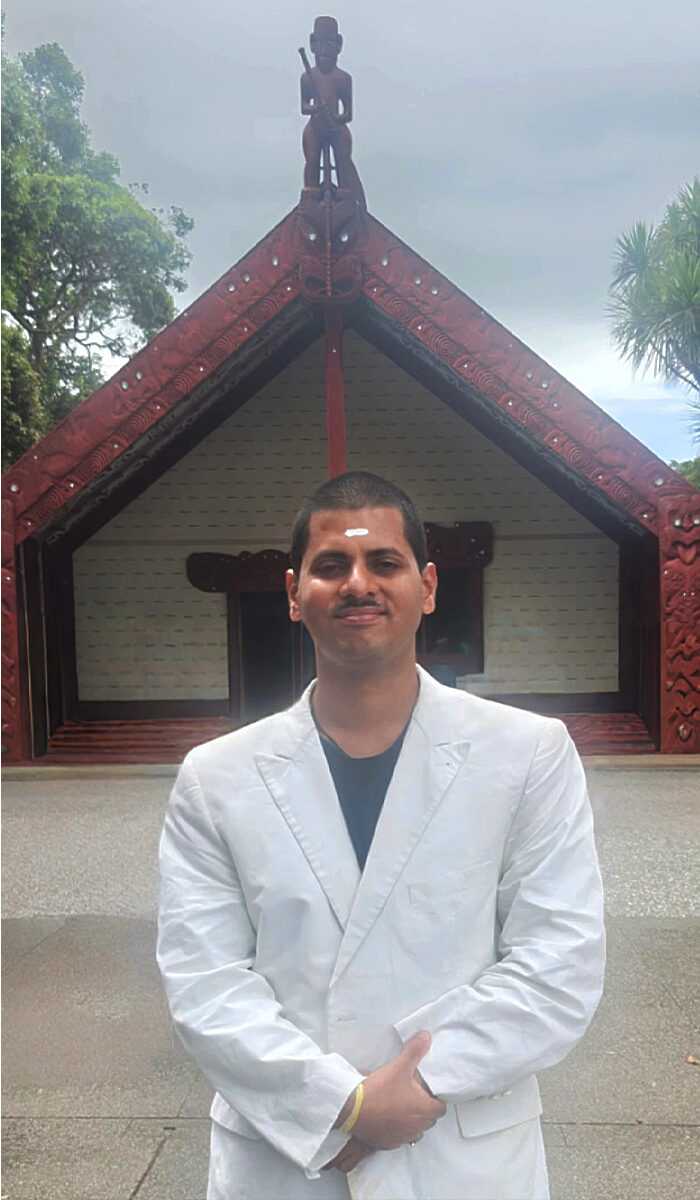
My recurring visits to Mandirs and Maraes, give me a deep sense of appreciation as a Hindu New Zealander. Being in that space, you don’t just see carvings or Murtis, you feel the presence of the tīpuna, the forebears who have walked this land before us, who built these spaces, and the values they chose to bequeath to their future generations. The metaphysical aspects of both Sanatana Dharma, and Te Ao Māori can be quite identical, and give us better perspectives on our shared worldview, something I do not see being replaced by AI yet, not until AI can achieve sentience. It’s our collective role to look after the stories, the cultures, and the spaces, so it’s there for the next generation, and their next generations.
I strongly opine, as a Kiwi-Hindu, that the Varnashrama Dharma, the caste-system is a virtuous concept in keeping Sanatana Dharma resilient to external hate and threats over millennia, and an asset if we, as Kiwi-Hindus, are keen in having this conversation in good faith with our fellow New Zealanders. The concept of rangatira (chief or leader) and tohunga (priest/expert/pandit) in Māori culture is traditionally a process rooted in whakapapa (genealogy), but also demonstrated ability (pono and manaaki), and community consensus(kaupapa) , mirroring our own lived perspectives of the Varnashrama Dharma.
I am inspired by those voices, Maori and non-Maori, who defend these institutions of mana whenua in their wider defence of Te Tiriti, and I believe that we, as young/Yuva/rangatahi Kiwi-Hindus, need to comprehend and empathise with this approach, and mentally decolonise ourselves, stop being guilt-trapped about the caste-system, and most importantly, bequeath this cultural pride with a sense of history, theology and cultural pride in our identity, values and perspectives as Kiwi-Hindus, especially when we bestow our cultural and religious values to our younger generations, and their future generations.
I support both Te Tiriti and the Ayodhya Ram Mandir, especially with the mana around their connection to the land and the legacy of institutional struggles in reclaiming lost glory. Voices, public and non-public, who support just one and oppose the other, are sheer hypocrites. –by CVR Shastri, (C V R Shastry is a Kiwi-Hindu based in Auckland Central. He values Auckland’s vibrant, diverse culture, its arts scene, and its strong learning spaces, including university campuses and the Auckland Central Library).