


Please Contribute Here to help us Grow!
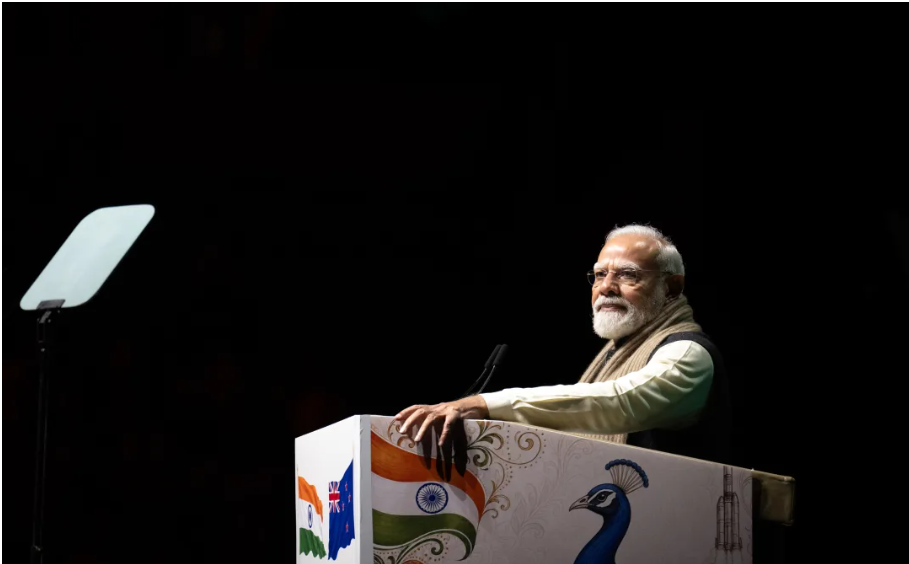
Indian Prime Minister Narendra Modi appeared before a sizeable audience for a little more than an hour at a community event in Auckland during his whirlwind visit earlier this month.
But behind his appearance were months of planning, rehearsals and security preparations that involved hundreds of organisers and volunteers.
From installing podiums flown in from India and last-minute security checks to stringent rehearsals and strict protocols, those involved in organising the community event said hosting one of the world’s most closely guarded leaders came with a unique set of challenges.
Modi concluded his trip with an address to more than 10,000 members of the Indian diaspora at Auckland’s Spark Arena, marking the first visit by an Indian prime minister to New Zealand in 40 years.
But before Modi even stepped onto the stage, organisers ran a 20-minute video to test camera angles, podium positioning and every detail of the security setup.
The heightened security surrounding Indian prime ministers is a consequence of two deadly attacks on the country’s political leaders in the 1980s and ’90s.
Prime Minister Indira Gandhi was assassinated by two of her bodyguards in 1984, while former Prime Minister Rajiv Gandhi was killed in a suicide bombing at a campaign rally in 1991.
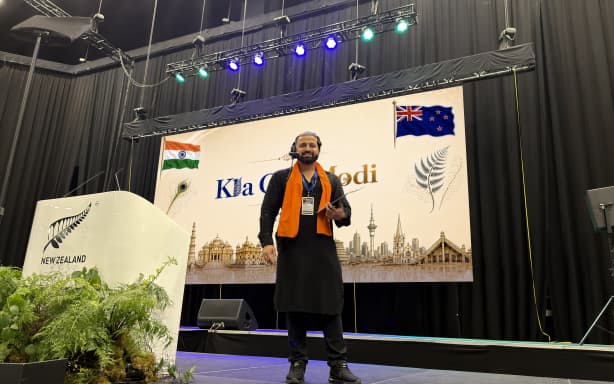
Rahul Chopra, an Auckland high school teacher who was stage manager for the Kia Ora Modi event, was among those responsible for making sure everything went according to plan.
“I’m really grateful for the opportunity,” Chopra said.
“It felt like I was witnessing history, with an Indian prime minister visiting New Zealand after 40 years. I wasn’t even born when the last Indian prime minister came here.”
The opportunity came with a lot of protocols and responsibilities.
The behind-the-scenes preparations offered organisers and volunteers a rare glimpse into the meticulous planning and tight security that typically accompanies an overseas trip by an Indian prime minister.
“There [was] a stage for performers and then there [was] a stage in front of that stage which is only for the prime minister,” he said, adding that dancers weren’t even allowed to step on it.
Supplied
Chopra was surprised to see such special requirements as part of the security protocol.
“We’re not used to security like this,” he said.
“We’re used to prime ministers hanging out with us here in New Zealand.”
Earlier in the month, New Zealand security officials conducted motorcade rehearsals and extensive security preparations ahead of the Indian prime minister’s arrival.
Vinay Mehta, a building inspector in Auckland, was also part of the organising committee.
Mehta was responsible for looking after the Indian prime minister’s personal requirements, which included helping to erect a podium for Modi to stand on before his speech and dismantle it afterwards.
“We were liaising with the SPG (Special Protection Group) with everything,” he said.
The SPG is an elite Indian security force that provides protection to the prime minister, former prime ministers and immediate family members.
We had to erect it,” he said. “Then we had to dismantle it, put it back into the big, big boxes.”
Mehta said the security protocols were extremely strict, with everything planned and checked by Indian officials.
“We could call it red tape, but it’s also the level of detail and the approval needed,” he said.
Chopra said the stage was checked multiple times, with organisers playing a video for 20 to 30 minutes while security officials swept the stage and areas where the Indian prime minister would be.
“They recheck everything,” he said. “I don’t know what they check but they recheck everything.”
Chopra said he was scolded by security officials multiple times while managing the stage.
“I understand how these things work in India,” he said.
“The protocols are important and he’s the Indian PM, but we’re not used to these things here in New Zealand.”
He said Indian officials who manage Modi’s overseas programmes were brought in to work alongside local organisers to guide them through the process.
Chopra said one of the biggest challenges was getting approvals for even the smallest details of the event.
“Approvals were a big challenge and we had to get approval [from India] for everything, from the programme to what the script MC would say,” he said.
He said the level of scrutiny extended to every part of the stage setup, including the backdrop behind Modi’s podium during his speech.
“The backdrop [behind] where [Modi] was speaking was checked more than seven times, and you wouldn’t even notice the difference from version six to version seven,” he said.
“The level of detail and how far the security protocols would go was eye-opening.”
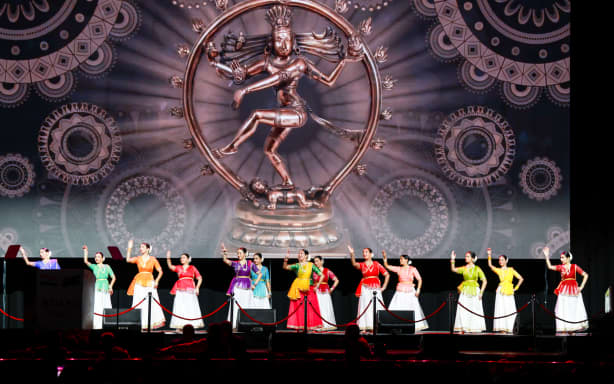
The Kia Ora Modi event was organised by the NZ Bhartiya Diaspora Group, with the programme featuring cultural performances from different states across India that showcased the country’s rich heritage, diversity and traditions for more than four hours.
Modi’s visit came as New Zealand and India look to deepen ties following the signing of a free trade deal last year and the establishment of a joint working group on counterterrorism aimed at strengthening cooperation on combating terrorism and violent extremism, as well as intelligence sharing.
Several cultural performers took to social media after the community event ended, accusing organisers of poor management.
Some complained of truncated stage windows, with several groups expressing unhappiness at their acts being cut short midway through the performance.
RNZ has approached organisers for comment about such complaints.
Chopra said the decision to cut some performances short was a result of timing pressures.
“From my perspective, it was an unfortunate situation driven by last-minute timing constraints rather than a lack of respect for the performers,” he said.
“It wasn’t the outcome any of us wanted, but we made the best decisions we could in a rapidly changing environment.”
Despite the challenges, Chopra said the experience of being part of the event was something he would remember.