



Please Contribute Here to help us Grow!
The Indian community in New Zealand has long been recognised for its hard work, entrepreneurial spirit and commitment to building a better future. A landmark report released in July 2026 by Infometrics, commissioned by the Waitakere Indian Association, now confirms what many have witnessed over the past decade—the Kiwi Indian diaspora has evolved from a migrant success story into one of New Zealand’s most significant economic and social pillars.
The findings reveal a community that is no longer simply contributing to the country’s prosperity but increasingly shaping its future through business, innovation, professional excellence and global connections.
A $37.3 Billion Contribution to the Economy
The report estimates that Indian New Zealanders generated an extraordinary $37.3 billion in economic activity during the year ending March 2025, accounting for 8.6 per cent of New Zealand’s Gross Domestic Product (GDP). This contribution supports nearly 221,000 full-time equivalent jobs, highlighting the community’s growing influence across every sector of the economy.
Indian-owned businesses remain the biggest driver of this success, contributing almost three-quarters of the overall economic impact. Household spending by Indian families accounts for around one-quarter, while international students and visitors from India continue to provide valuable support to the country’s education and tourism sectors.
The report further shows that almost half of the total economic contribution comes directly from Indian businesses and workers, while the remainder flows through supply chains and wider consumer spending, creating a multiplier effect that benefits the entire New Zealand economy.
Among the strongest-performing sectors are rental and property services, retail and hospitality, professional services, transport, construction and healthcare, demonstrating the community’s increasingly diversified economic footprint.
Fastest Growing Major Ethnic Community
The Indian diaspora is now New Zealand’s largest ethnic minority after Māori and Pacific peoples.
Between 2018 and 2023, the Indian population grew by 27 per cent, reaching approximately 330,000 people, representing 5.8 per cent of New Zealand’s total population. The community has now surpassed the Chinese population in size and continues to be one of the country’s fastest-growing demographic groups.
The report projects that by 2043, the Indian population could reach 626,000, representing almost one in every ten New Zealanders.
Equally significant is the community’s youthful demographic profile. At a time when New Zealand faces an ageing workforce, Indian New Zealanders are expected to play an increasingly important role in filling skills shortages and supporting long-term economic growth.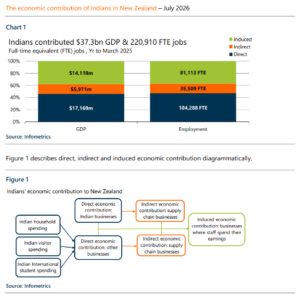
Highly Skilled, Highly Educated and High Performing
Education continues to be one of the defining strengths of the Indian community.
Nearly 46 per cent of Indian New Zealanders hold a bachelor’s degree or higher, significantly above the national average of 27 per cent. Many graduates specialise in management, commerce, engineering, information technology, health sciences and other high-demand professions.
This strong educational background is reflected in workforce participation.
Around 63 per cent of Indians aged 15 years and over are employed full-time compared with 51 per cent nationally. Their growing presence across software engineering, healthcare, finance, education, research and professional services has helped lift both productivity and household incomes.
Median personal income among Indian New Zealanders reached $51,600 in 2023, substantially above the national median of $41,500. Median household income stood at $132,100, around 36 per cent higher than the New Zealand average.
The report also highlights that Indian incomes have grown faster than the national average over the past five years, reflecting the community’s increasing movement into highly skilled occupations and leadership positions.
Entrepreneurship Driving Growth
Entrepreneurship remains one of the defining characteristics of the Kiwi Indian community.
By March 2024, New Zealand was home to approximately 33,700 Indian-owned businesses, representing more than 6 per cent of all businesses nationwide.
While transport, retail and professional services continue to dominate, Indian entrepreneurs are rapidly expanding into technology, healthcare, construction, manufacturing, financial services and other knowledge-based industries.
The report notes that industry diversification has steadily increased over recent years, making Indian businesses more resilient to changing economic conditions while creating new employment opportunities across the country.
The rise in self-employment—from 16 per cent to 19 per cent between 2018 and 2023—also demonstrates growing confidence among Indian entrepreneurs in building businesses that contribute to both local communities and the national economy.
Strengthening India-New Zealand Relations
The report comes at a particularly significant time following the signing of the New Zealand–India Free Trade Agreement (FTA) in April 2026.
The agreement is expected to further strengthen trade, investment, education and skilled migration between the two countries. Bilateral trade had already reached nearly $4 billion in 2025, with the FTA expected to unlock substantial new opportunities for exporters, professionals and investors.
Education continues to be another major pillar of the bilateral relationship.
Although international student numbers have not yet fully recovered to pre-pandemic levels, spending by Indian students has increased considerably as more students choose postgraduate and higher-level university programmes. Master’s enrolments have recorded exceptional growth, underlining India’s importance as one of New Zealand’s key education markets.
Tourism is also rebounding strongly. More than 81,000 Indian visitors travelled to New Zealand during 2025, generating approximately $336 million in tourism expenditure. Nearly half of these visitors travelled primarily to visit family and friends, highlighting the growing importance of New Zealand’s Indian diaspora in sustaining international travel between the two countries.
Challenges Remain
Despite remarkable achievements, the report acknowledges several ongoing challenges facing the community.
Small business owners continue to face higher levels of retail crime, while migrant exploitation remains a concern for vulnerable workers. Many internationally qualified professionals, including healthcare workers and nurses, continue to experience delays in recognition of overseas qualifications despite existing workforce shortages.
Higher immigration and visa costs have also placed additional financial pressure on students and new migrants.
The report points out that almost 60 per cent of overseas-born Indian New Zealanders have arrived within the past decade, meaning many families are still in the early stages of settlement. As these newer migrants establish careers, businesses and home ownership, their long-term contribution is expected to grow even further.
From Economic Success to National Leadership
The Infometrics report concludes that the Indian diaspora has reached an important turning point.
Its contribution can no longer be measured solely through GDP or employment figures. The community is increasingly influencing New Zealand’s business landscape, workforce, innovation ecosystem and international relationships.
The report encourages Indian New Zealanders to build upon their economic success by taking greater leadership roles in public life, governance, corporate decision-making and community advocacy. At the same time, it calls on policymakers to remove barriers to professional recognition, strengthen support for ethnic businesses and harness the community’s deep global connections.
The message is clear: the Kiwi Indian diaspora is no longer simply helping to build New Zealand’s future—it is becoming one of the key forces shaping it.-TIN Bureau