


Please Contribute Here to help us Grow!
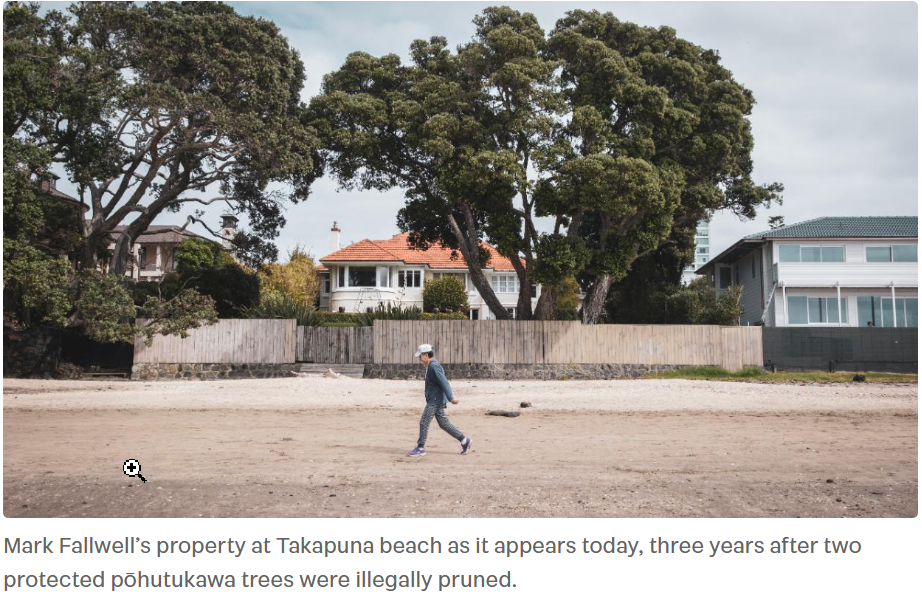
Mark Fallwell didn’t like the fact that two 80-year-old pōhutukawa trees were blocking the view from his $15.7 million beachside property at Takapuna so he got them cut back.
The problem was, the trees were protected – a detail Fallwell, 85, failed to check before hiring a contractor to cut them – and he soon came to the attention of Auckland Council.
It was on Friday, March 1, 2024, when a member of the public called the council to say one of trees just behind Takapuna beach was being trimmed in a concerning manner.
Council staff went to the scene and found that a pōhutukawa at the end of an accessway to several properties had been pruned, with large branches cut off.
The trees had not been pruned well, and the work fell short of arboricultural best practice.
The trees were 80-100 years old.

When council staff spoke to Fallwell, he said he had contacted the owners of a couple of neighbouring properties to discuss the pruning and they didn’t object.
The council had to get a court production order to find out who Fallwell had paid to cut the trees. The contractor, who was paid $6000 by Fallwell, was also charged by the council.

Fallwell later changed his story to say he had the trees cut because they were obstructing his view of the beach and sea.
The pōhutukawa on Fallwell’s property is listed as a notable tree in the Auckland Plan, and the other one was protected due to its height and proximity to the beach. That means resource consent is required before any alteration or trimming of the trees can occur.

He appeared in the Auckland District Court in December.
The council told Judge Sheena Tepania that notable trees are among the most significant trees in Tāmaki Makaurau and had been specifically identified due to their historical, cultural and environmental value and to ensure that the benefits they provide are retained for future generations.
The council said the pruning had negatively affected the health and stability of the two trees. About 20% of the canopy cover of the tree on Fallwell’s property had been removed, meaning its health may decline. It will take decades for the canopy to fill in again.
Both trees were highly visible, the council said, and the pruning meant houses were more visible from the beach, resulting in a loss of amenity value of the Takapuna beachfront.

The council argued that Fallwell was culpable of gross carelessness or gross recklessness, and he should have checked if the trees were protected before having them cut.
Judge Tepania doubted Fallwell was unaware that the trees were protected as his family had owned the property for nearly 40 years, and she said he could have easily informed himself of the trees’ status.
“It is a reasonable expectation that persons who seek to have work carried out on indigenous trees of such an age, 80-100 years old, will demonstrate prudence in their actions and undertake the necessary checks with council. A simple phone call inquiry to council is not an unreasonable expectation when dealing with trees of such significant value,” the judge said in her decision released this month.
Fallwell’s offending was highly careless, she said. He failed to make a simple inquiry of council regarding the work, was motivated by his desire to enhance his views of the beach and sea, and showed poor judgment by failing to obtain the permission of all the landowners in relation to the pōhutukawa on the accessway.
Judge Tepania noted Fallwell was remorseful, and that he was a person of good character and pleaded guilty early.
He was convicted and fined $21,000. Ninety per cent of the fine will be paid to the council.
Fallwell’s 1604m² property has a council valuation of $15.7m.
The contractor was also charged and will be sentenced in May.
“Where there is evidence to support a prosecution, we will look to prosecute in most cases where remediation is not possible and infringement penalties available do not reflect the scale of offending,” he said.
Fallwell could not be reached for comment.