


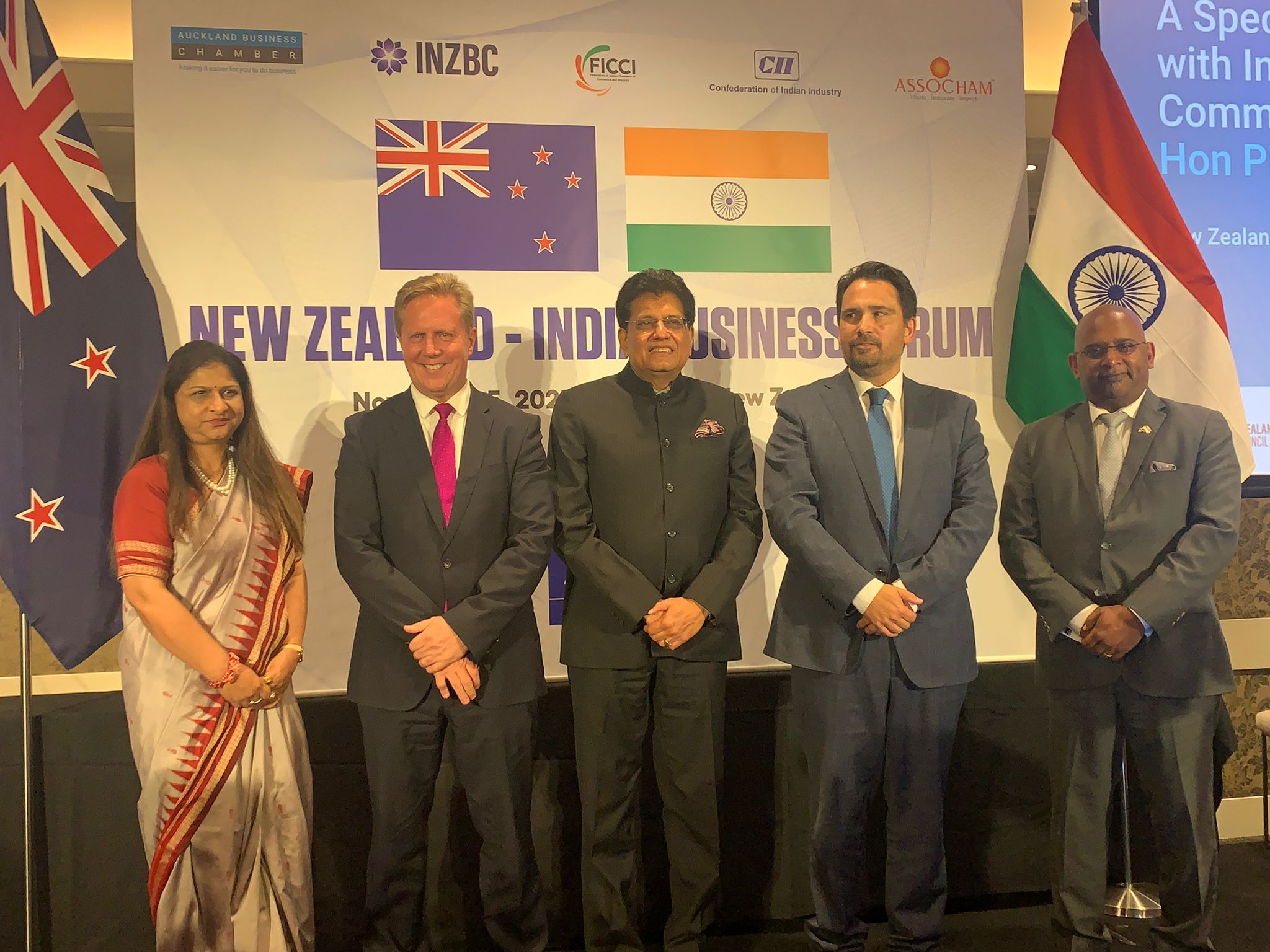
India and New Zealand have launched the fourth round of negotiations in Auckland for their proposed Free Trade Agreement (FTA), marking another major step toward deepening bilateral economic relations. According to India’s Ministry of Commerce and Industry, this round, which began on November 3, focuses on key areas such as trade in goods and services and rules of origin. Both nations aim to build on progress from earlier discussions and move closer to concluding the much-anticipated deal.
Commerce and Industry Minister Piyush Goyal will be in Auckland this week to meet his New Zealand counterpart, Minister for Trade and Export Growth Todd McClay, to review the progress of the talks. The negotiations were formally relaunched on March 16 this year following a meeting between the two ministers in New Delhi. Since then, three formal rounds and one inter-sessional mini-round have been held, gradually narrowing differences. The third round, concluded in Queenstown in September, recorded “constructive discussions and significant progress,” the ministry said.
Minister Goyal will arrive in Auckland on November 5 for a series of meetings with senior government officials, business leaders, and industry representatives. He will also participate in a business forum jointly organised by the India New Zealand Business Council (INZBC) and the Auckland Business Chamber, focusing on cooperation in trade, education, technology, agritech, and renewable energy. The Indian delegation includes representatives from major chambers such as FICCI, CII, and ASSOCHAM, highlighting the strong role of industry in shaping the FTA.
Previous negotiation rounds have covered areas like digital trade, e-commerce, customs facilitation, and investment cooperation. The inter-sessional mini-round in New Delhi in October helped align technical chapters ahead of the current talks. For New Zealand, the top priorities include securing improved market access for agricultural exports, particularly dairy, meat, and horticultural products, along with stronger investment protections and simplified customs procedures. India, in turn, seeks greater access for its pharmaceuticals, auto components, processed foods, and IT services, as well as recognition of professional qualifications and more flexibility for short-term work mobility.
Dairy remains the most politically sensitive issue. India’s dairy sector consists of millions of small farmers, making liberalisation a complex and delicate topic. However, New Zealand’s dairy industry, led by Fonterra, views India as a key long-term growth market given its expanding consumer base and increasing demand for high-quality dairy products.
Beyond trade in goods, both countries are expanding cooperation in education, technology, and sustainability. India continues to be one of New Zealand’s largest sources of international students, and both sides are exploring new transnational education partnerships. There are also growing opportunities for collaboration in emerging areas such as artificial intelligence, fintech, cybersecurity, and renewable energy—reflecting the widening scope of bilateral engagement.
India’s trade diplomacy has gained momentum in recent years, with successful FTAs signed with Australia, UAE, UK and EU. For New Zealand, a deal with India would diversify its export markets and strengthen its position across the Indo-Pacific. Experts such as Professor Siah Hwee Ang from Victoria University of Wellington believe an India–New Zealand FTA could unlock significant opportunities for exporters while deepening regional economic cooperation.
While optimism is growing, both sides acknowledge that finalising the agreement will take time. The focus now is to complete technical chapters by early 2026, with politically sensitive issues, especially agricultural access, to be addressed later. Negotiators have reported progress on customs facilitation, investment cooperation, and digital trade, while continuing discussions on services, rules of origin, and food safety standards.
The Ministry of Commerce has described New Zealand as a “natural partner” for India in sustainable agriculture, renewable energy, and education. A successful FTA would strengthen New Zealand’s Indo-Pacific engagement, diversify its export portfolio, and integrate India more closely with Pacific trade networks. The Auckland meetings may result in a joint ministerial statement reaffirming both nations’ commitment to accelerating progress.
A draft agreement could be ready by mid-2026, potentially aligning with India’s ongoing trade reviews with ASEAN and Japan and exploratory talks with the Gulf Cooperation Council. While an immediate signing is unlikely, Minister Goyal’s visit is expected to strengthen goodwill, align strategic priorities, and reinforce the growing feasibility of an India–New Zealand economic partnership. If the current momentum continues, 2026 could mark the beginning of a new era in bilateral trade, opening opportunities across education, technology, agritech, and renewable energy while enhancing both countries’ roles in the Indo-Pacific region. -TIN Bureau