

New Zealand’s latest quarterly update on its nine key government targets—established to guide the public sector toward long-term national priorities—paints a picture of mixed progress. While several goals are firmly on track or already achieved, four major targets are now rated “at risk”, particularly in the crucial areas of employment and education. The update, reflecting data up to September 2025, underscores that although meaningful progress has been made in certain sectors, others demand decisive and sustained intervention if the nation is to meet its 2030 goals.
One of the most pressing challenges remains the rising number of New Zealanders on the Jobseeker benefit, which has reached 217,800, an increase of 1,800 since June. The government’s long-term target is to bring this figure down to 140,000 by 2030, making the current gap significant. Officials suggest that improving economic conditions will gradually reduce pressure on the benefit system; however, the scale of the issue indicates that more robust strategies will be necessary. Measures introduced so far include stricter sanctions through a traffic light system and a newly revised eligibility test for young applicants aged 18 and 19, which restricts access for those whose parents earn above a set income threshold. Nonetheless, the trends indicate that the road ahead will be challenging.
Education remains another area where progress is lagging. Targets for improving reading, writing, and mathematics are all considered “at risk,” with only 47% of students meeting expectations in reading, 24% in writing, and 23% in mathematics. Although structured literacy programmes and curriculum updates have been rolled out across schools, improvements have been incremental at best. Attendance, however, offers a glimmer of hope. While Term 2 attendance sits at 58.4%, far from the 80% target, officials say it remains “probable” that the goal can still be reached. Legislation requiring mandatory attendance management plans beginning in 2026 aims to address long-standing patterns of truancy and absenteeism. Historical data shows that attendance typically dips in winter months due to illness, but long-term trends suggest this will continue to be a difficult target to meet without strong intervention.
The health sector shows moderate improvement but remains under considerable strain. Two major health targets are classified as “feasible,” meaning achievable but with significant risks. Emergency department performance is especially concerning only 73.9% of patients are processed within the six-hour window, well below the 95% target. Experts warn that ED overcrowding cannot be solved in isolation—system-wide reforms involving primary care, aged care, and hospital bed management are required. A $20 million boost to ED staffing and $164 million over four years for urgent and after-hours care represent meaningful steps forward, yet transformational change will be needed to achieve 2030 goals. Elective treatment wait times show improvement—now 63.9% of patients are treated within four months—but still fall short of the 95% requirement.
There are notable successes. The target to reduce households in emergency accommodation has been surpassed dramatically. From a baseline of 3,141 households, the number has dropped to 441, far exceeding the 2030 target of 800. Increased access to social housing and stricter placement criteria contributed to this achievement, though officials caution that tightened criteria may lead to higher rates of rough sleeping.
Crime reduction targets have also been achieved ahead of schedule. The number of serious and persistent youth offenders has fallen to 892, beating the target of 900. Additionally, broader crime reduction goals—particularly in reducing victims of assault, robbery, and sexual assault—are on track, supported by initiatives such as stronger sentencing and improved security measures. Climate goals present cautious optimism. Emissions for 2022–2025 are projected at 282.2 megatonnes, below the 290 mt target. The following period (2026–2030) remains challenging but is currently on track. In summary, New Zealand’s target progress reveals a landscape of strong successes alongside significant risks. Continued investment, coordinated reforms, and strong policy leadership will be essential to ensure the country meets its ambitions by 2030.
-TIN Bureau
Four of Nine Government Targets Falling Behind, Report Finds!

ByThe Editor The Indian News
Dec 4, 2025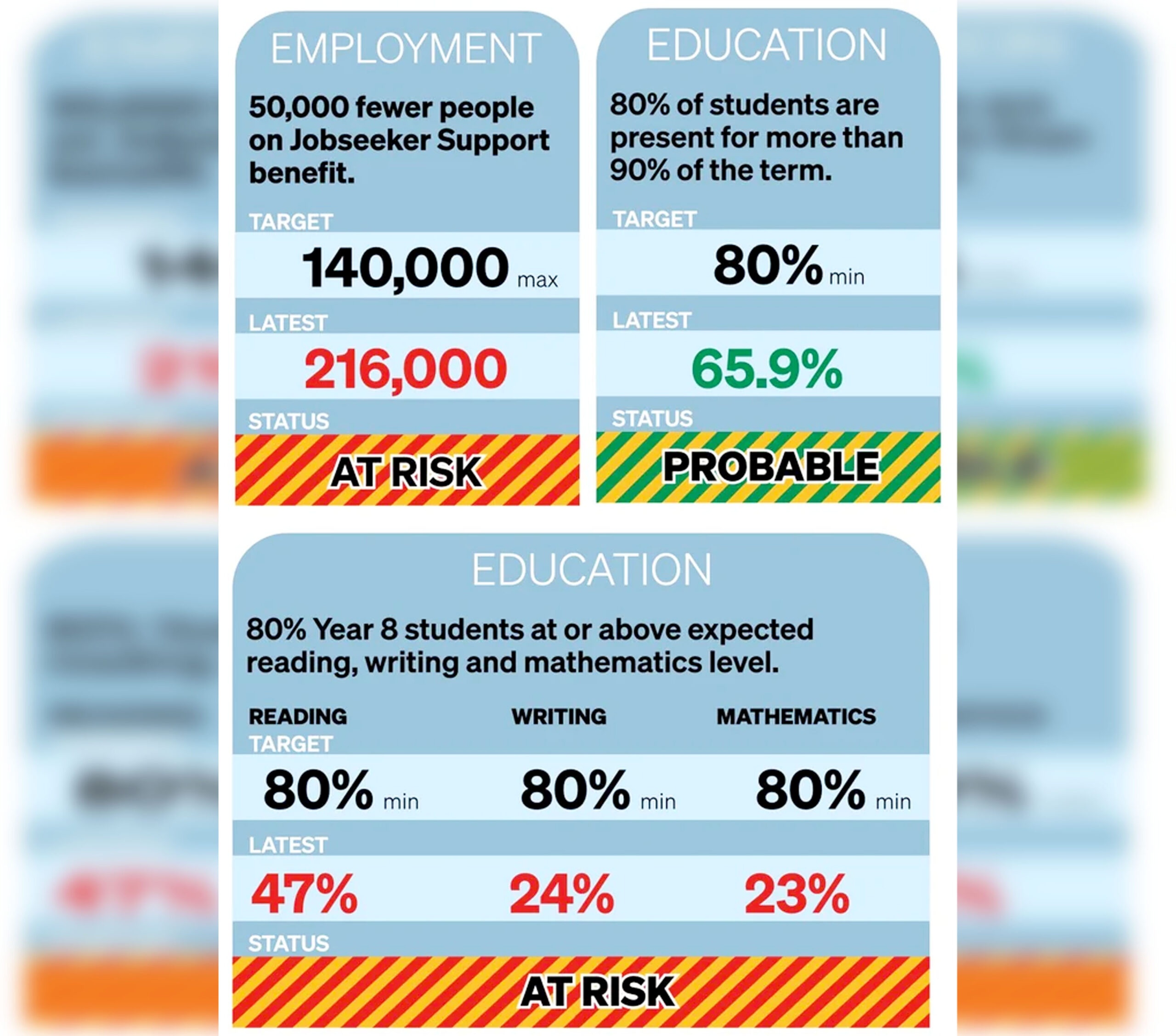
By The Editor The Indian News
Yugal Parashar, Editor, The Indian news